Pages

Showing posts with label Country. Show all posts

Friday, 30 August 2013

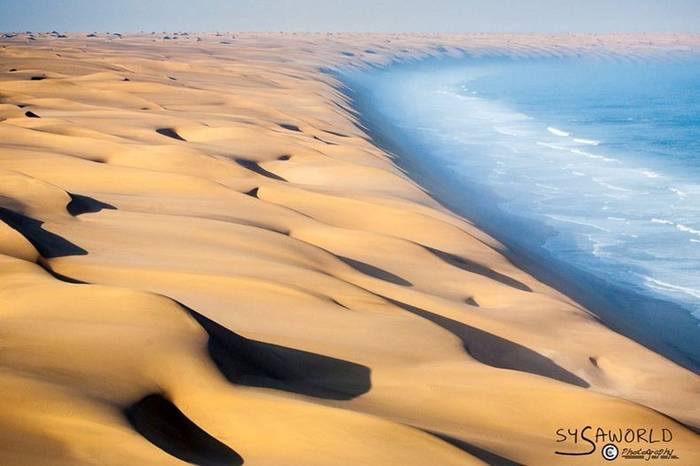
Desert and Ocean Meets — Namib

The Southern Namib desert is home to some of the tallest and most spectacular dunes of the world, ranging in color from pink to vivid orange. These dunes continue right to the edge of the Atlantic Ocean. The cold waters of the sea brushing against the dunes of the Namib desert is one of the most surreal sights.

Photo — Link

The Southern Namib desert is home to some of the tallest and most spectacular dunes of the world, ranging in color from pink to vivid orange. These dunes continue right to the edge of the Atlantic Ocean. The cold waters of the sea brushing against the dunes of the Namib desert is one of the most surreal sights.

While the sea coast extends for hundreds of miles, one of the best places to see these dunes is at Swakopmund. Known as Swakop in Namibia, it is the country's biggest coastal town and a mecca for Namibians on holiday. The city's German origins are quite pronounced in beautiful old German Colonial buildings throughout the city, making an even starker contrast for this town sitting at the edge of the Namib Desert. 13 more images after the break...

Thursday, 29 August 2013

The World's Biggest Megacities


20. Buenos Aires
Buenos Aires is known for its European style architecture and culture, a legacy of the Spanish and Italian origins of most of the population. It has the highest concentration of theatres in Latin America and is the birthplace of Tango music and dance.
Urban area: 13.5 million people
City: 2.9 million people

According to the 2012 edition of Demographia's World Urban Areas index, the capital of Argentina is the second largest urban area in South America after Sao Paulo. Its per capita income is among the highest in Latin America and its quality of life is ranked number one in the region, although some estimates say that 4 million people in the area live in poverty. It is also reportedly the most visited city in Latin America.

Urban Detail — Buenos Aires is known for its European style architecture and culture, a legacy of the Spanish and Italian origins of most of the population. It has the highest concentration of theatres in Latin America and is the birthplace of Tango music and dance. (Source: Reuters) 19 more after the break...

Wednesday, 28 August 2013

Zaha Hadid's Sleek Metro Station in Saudia Arabia


World renowned architect Zaha Hadid has just won a competition to design the new metro station for Saudia Arabia's capital city Riyadh. The city's population has doubled since 1990 and is now home to more than 5 million people. Due to this large influx of citizens, the city has now started planning a brand new metro system to better aid them in their day to day life.

World renowned architect Zaha Hadid has just won a competition to design the new metro station for Saudia Arabia's capital city Riyadh. The city's population has doubled since 1990 and is now home to more than 5 million people. Due to this large influx of citizens, the city has now started planning a brand new metro system to better aid them in their day to day life.

Located in the King Abdullah Financial District, Hadid architect's proposal is a four story building that will feature six train platforms, two levels of underground parking, and even access to the cities pre-existing monorail line by use of a sky bridge. Much thought has been given into diminishing congestion by using a series of pedestrian walkways that run throughout the building without interfering with commuters and travelers.

Other design aspects of this project are the undulating waves featured on the walls and roof that are meant to symbolize Saudia Arabia's rolling desert dunes and give the building its unique fluid look. The structure's woven latice facade is designed to allow natural light to enter the interior of the station without causing a harsh glare. The estimated completion date of this project is 2017 and is sure to be an iconic landmark for the city of Riyadh. 05more images after the break...

Monday, 26 August 2013

Horizontal Waterfalls in Australia


Horizontal Waterfalls in Australia

It is strange to hear this combination of words. However, it is a fact. In the Australian Talbot Bay are several unusual waterfalls that appear only at high tide, which makes the definition of waterfall controversial.

The maximum difference between the highest and the lowest point of the falls is only about five meters. In the same time, the width of the gorges through which rushes the water is in one case about 10 meters and in other about 20 meters. The two waterfalls are the connecting openings between the Talbot Bay and the Poulton Creek. The gorges are located on the McLarty Range on a distance of about 300 meters from each other.14 more images after the break...

Floating Hotels in Qatar


Floating Hotels in Qatar

If there’s an intractable urban problem, whether involving housing thousands of people or preparing for an attention-grabbing event, there is always a one-step solution: Make it float!

This is Qatar’s plan, at least, for the 2022 World Cup. Faced with mounting criticism of its preparations for the event, and worries that it will not be able to manage hosting the thousands of attendees, the Gulf state has decided to look into several floating hotels that together would be capable of handling upwards of 25,000 people. 08 more images after the break...

Rozenburg Wind Wall

Rozenburg is a small port town and former municipality in the western Netherlands, in the province of South Holland. After the second World War, the port of Rozenburg grew almost explosively along the Nieuwe Maas river towards the sea. To handle the burgeoning sea traffic, a canal was built in the late 1960s running parallel to the already present Nieuwe Waterweg canal.

Rozenburg is a small port town and former municipality in the western Netherlands, in the province of South Holland. After the second World War, the port of Rozenburg grew almost explosively along the Nieuwe Maas river towards the sea. To handle the burgeoning sea traffic, a canal was built in the late 1960s running parallel to the already present Nieuwe Waterweg canal.
Photo — Link

The Caland canal - named after a Dutch civil engineer who was responsible for building of the Nieuwe Waterweg - served as an access for deep draft vessels, in particular bulk carriers and tankers of increasing dimensions that called at the Europoort docks. The narrow waterway, however, became increasingly difficult to navigate in strong winds, particularly around the Calandbrug bridge, as the ships became larger.

In the mid-1980s architect Martin Strujis and artist Frans de Wit were called upon for the task of creating an effective yet aesthetically pleasing wind barrier. The Rozenburg Windwall was the result of their effort. 14 more images after the break...

Akhmad Kadyrov Mosque in Grozny — Chechnya

The Akhmad Kadyrov Mosque (Russian — Mechet Akhmata Kadyrova) is located in Grozny, the capital of Chechnya. It is one of the largest mosques in Russia and is officially known as the "The Heart of Chechnya" , Russian — Serdtse Chechni). The mosque is named after Akhmad Kadyrov who commissioned its construction from the mayor of Konya. The mosque design with a set of 62-metre (203 ft)-tall minarets is based on the Blue Mosque in Istanbul. On October 16, 2008, the mosque was officially opened in a ceremony in which Chechen leader Ramzan Kadyrov spoke and was with Russian Prime Minister Vladimir Putin. In this mosque, ten thousand Muslims can pray at a time and its minarets reach 62 metres (203 ft) high.
Photo — Link

The Akhmad Kadyrov Mosque (Russian — Mechet Akhmata Kadyrova) is located in Grozny, the capital of Chechnya. It is one of the largest mosques in Russia and is officially known as the "The Heart of Chechnya" , Russian — Serdtse Chechni). The mosque is named after Akhmad Kadyrov who commissioned its construction from the mayor of Konya. The mosque design with a set of 62-metre (203 ft)-tall minarets is based on the Blue Mosque in Istanbul. On October 16, 2008, the mosque was officially opened in a ceremony in which Chechen leader Ramzan Kadyrov spoke and was with Russian Prime Minister Vladimir Putin. In this mosque, ten thousand Muslims can pray at a time and its minarets reach 62 metres (203 ft) high. 21 more images after the break...

Madrid-Puerta De Atocha Railway Station — Spain

Madrid Atocha (Spanish: Estación de Madrid Atocha, also named Madrid Puerta de Atocha) is the largest railway station in Madrid. It is the primary station serving commuter trains (Cercanías), intercity and regional trains from the south, and the AVE high speed trains from Barcelona (Catalonia), Saragosse (Aragon), Seville (Andalusia) and Valencia (Levante Region). These train services are run by the Spanish national rail company, Renfe. The station is in the Atocha neighborhood of the district of Arganzuela. The original façade faces the Plaza del Emperador Carlos V, a site at which a variety of streets converge, including the Calle de Atocha, Paseo del Prado, Paseo de la Infanta Isabel, Avenida de la Ciudad de Barcelona, Calle de Méndez Álvaro, Paseo de las Delicias, Paseo de Santa María de la Cabeza, and Ronda de Atocha.

Madrid Atocha (Spanish: Estación de Madrid Atocha, also named Madrid Puerta de Atocha) is the largest railway station in Madrid. It is the primary station serving commuter trains (Cercanías), intercity and regional trains from the south, and the AVE high speed trains from Barcelona (Catalonia), Saragosse (Aragon), Seville (Andalusia) and Valencia (Levante Region). These train services are run by the Spanish national rail company, Renfe. The station is in the Atocha neighborhood of the district of Arganzuela. The original façade faces the Plaza del Emperador Carlos V, a site at which a variety of streets converge, including the Calle de Atocha, Paseo del Prado, Paseo de la Infanta Isabel, Avenida de la Ciudad de Barcelona, Calle de Méndez Álvaro, Paseo de las Delicias, Paseo de Santa María de la Cabeza, and Ronda de Atocha.
Photo — Link

The Atocha station is really a railway complex, formed by the Madrid Atocha Cercanías and Madrid Puerta de Atocha stations of the Spanish national railways and the Atocha Renfe station of the Madrid underground. 11 more images after the break...

Giethoorn — The Dutch Village With No Roads


Can you imagine a village with no roads? There is such a place in the Netherlands called Giethoorn (pronounced 'geethorn'). There are no roads and cars have to remain outside the village. The only access to the stunningly lovely houses in Giethoorn is by water, or on foot over tiny individual wooden bridges.

Can you imagine a village with no roads? There is such a place in the Netherlands called Giethoorn (pronounced 'geethorn'). There are no roads and cars have to remain outside the village. The only access to the stunningly lovely houses in Giethoorn is by water, or on foot over tiny individual wooden bridges.
Photo — Link

Giethoorn is located about 5km southwest of Steenwijck in Holland and became famous - especially after the 1958 Dutch film "Fanfare", made by Bert Haanstra, was set there. Giethoorn is now an internationally known tourist attraction in the Netherlands. 20 more images after the break...

5 Hottest Places In The World

With summer finally here, it’s time for beach vacations, camping trips, water parks, picnics, and other outdoor activities reserved for the warmer months.

Of course, in many places, summer also means scorching temperatures, blazing sun, and mandatory air conditioning. While a tropical getaway and relaxing day at the beach may be on the top of your summer vacation list, you may start to rethink those options when the temperatures begin to rise.

Still, complaining about temperatures rising to 80 or 90 Fahrenheit will seem pretty pathetic after checking out this list of the hottest places on Earth. Just reading about these burning destinations will get you running for a cold shower. With temperatures too extreme to bear and climatically harsh and remote locales, the top 5 hottest places in the world are not to be messed with.

Counting down from the least hot (but still unbearable) in the top 5 to the hottest, here’s our list of the hottest places in the world.

05. Timbuktu, Mali
Located in West Africa, temperatures in Timbuktu can reach upwards of 130 Fahrenheit and average an uncomfortable 108 in the month of May. A key player in the spread of Islam to Africa, Timbuktu is home to several influential mosques and boasts the world’s most coveted collection of ancient manuscripts.  Regardless of its historical appeal, Timbuktu is only for those unaffected by super hot temperatures, or looking for a really good swea
Photo — Link

Located in West Africa, temperatures in Timbuktu can reach upwards of 130 Fahrenheit and average an uncomfortable 108 in the month of May. A key player in the spread of Islam to Africa, Timbuktu is home to several influential mosques and boasts the world’s most coveted collection of ancient manuscripts.

Regardless of its historical appeal, Timbuktu is only for those unaffected by super hot temperatures, or looking for a really good sweat. 04 more after the break...

Sunday, 25 August 2013

Dubai’s Lost Projects

As a change of pace from our usual Top Ten World Architecture series, we thought we’d celebrate the schemes that have fallen victim to the Credit Crunch and have either been put on hold or cancelled completely – and where better than Dubai, one of the fastest expanding cities in the world and home to the current tallest building in the world. Sadly, Dubai wasn’t immune to the worldwide recession, with the government at one stage having to rely on bailouts from Abu Dhabi to avoid defaulting on loans, and many of its more extreme projects were shelved due to financial restraints and lack of investment. We take a look at the best – and strangest – projects that are currently on hold or sadly may never be.

01. IRIS CRYSTAL TOWER
The Iris Crystal – left render from Iris; central and right render from Aedas
The Iris Crystal – Left render from Iris; central and right render from Aedas

Featuring a sinuous twist to a luxury commercial tower, The Iris Crystal was designed by Aedas as an eye-catching structure that took inspiration from its location at the head of an artificial bay and based its form on cascading water. The striking double skin exterior, made up of an inner façade of glazing protected by an outer solar screen, reminiscent of Arabic sun screens, was designed to protect the tower from solar gain. The tower was to be built in the Business Bay section of Dubai – a brand new ‘city within a city’ concept that was to be developed between 2008 and 2012-15. Many projects in this area have suffered from financial difficulties of some sort, and the Iris Crystal is no exception. Despite selling 60% of the available let space by June 2008, the tower has suffered massive delays, with no superstructure in place as yet and no official announcement as to when construction will begin again. 09 more after the break...